











At some point in every lab's early life, a founder looks at the cost of outsourcing an assay for the third time and thinks: we should just bring this in-house. The math seems obvious. The capability seems within reach. The decision feels like the next logical step in building out a lab.
Sometimes it is, but more often, it's a commitment made too early: before the volume is there to justify the infrastructure, before the team has the bandwidth to operate it, and before the frequency of need is clear enough to know whether the investment will pay off.
The Science Exchange Virtual Lab Manager team has developed a simple framework for this decision, based on honest answers to four questions.
Bringing a capability in-house too early is one of the most common — and costly — mistakes early-stage biotech labs make. Here's the framework that prevents it.The Four Questions That Drive the Build-vs.-Outsource Decision
Before committing to any in-house capability, the VLM team asks:
-
Volume: How many times will you need this per month, or per quarter? A capability you'll use twice a month looks very different from one you'll use twice a year.
-
Frequency: How regularly does the need arise? Sporadic, project-driven demand is different from a continuous workflow that's always running. High frequency justifies infrastructure. Low frequency usually doesn't.
-
Turnaround time: What's your acceptable wait for results? If you can wait two weeks for a CRO to return data, outsourcing works. If you need results within 48 hours to keep an experiment moving, that changes the calculus.
-
Customization: How proprietary or specialized is the work? Highly customized or confidential assays — work that requires your specific cell lines, your proprietary compounds, or your novel methods — are often strong candidates for in-house development regardless of volume, because finding an external vendor who can execute them reliably or safely becomes a challenge.
If volume is low, frequency is irregular, turnaround time is flexible, and the work isn't highly customized: outsource. If multiple factors are pushing the other direction, it's worth building the capability. The threshold is rarely one factor alone.
Why Outsourcing First Is Almost Always the Right Starting Point
Early-stage labs face a structural constraint that makes outsourcing the rational default: uncertainty.
You don't know yet which workflows will become high-frequency. You don't know which assays will be central to your science eighteen months from now and which will be abandoned. Building infrastructure for capabilities you haven't yet validated as core is a bet placed before the information is available to make it well.
CROs remove that constraint. They let you run the science, get the data, validate the approach, and understand the volume and frequency of the actual need, without committing capital to infrastructure. When the volume and frequency eventually justify building, you'll have the data to make that decision confidently rather than speculatively.
The VLM team's approach: outsource by default, and build only when the four-question framework consistently points toward in-house. Not when it feels like the right time, but when the data supports it.
CROs Are More Accessible Than Early-Stage Founders Often Assume
A common hesitation about CROs at the early stage is that they're built for large pharma, with minimum engagement sizes, long contracting timelines, and pricing structures that don't fit a seed-stage budget.
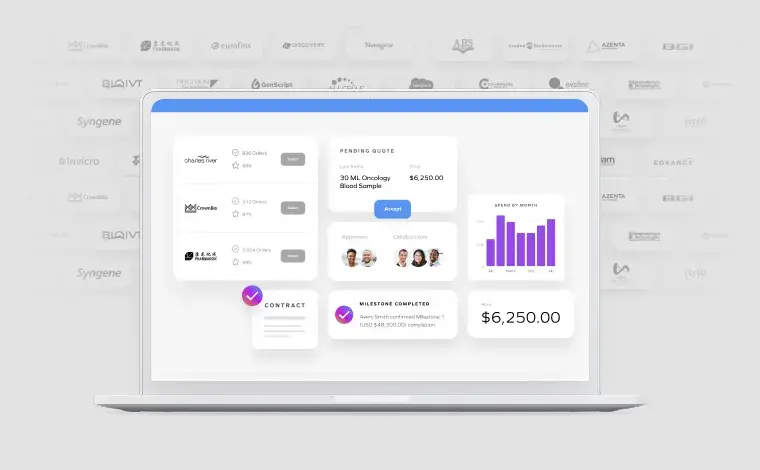
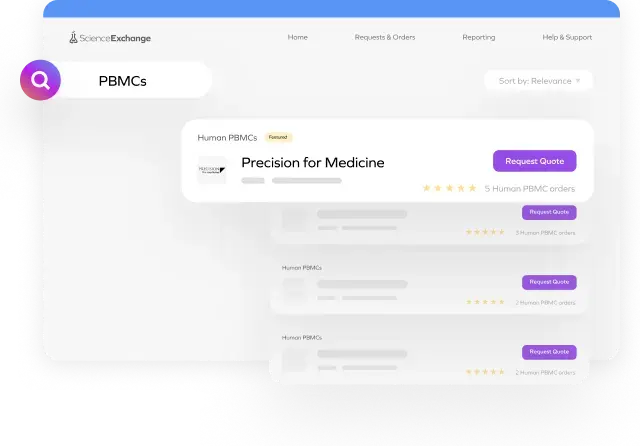
This is less true than it used to be. The CRO market has expanded significantly for small-biotech companies, with providers who specialize in early-stage clients, flexible engagement structures, and faster contracting. The Science Exchange network includes thousands of pre-qualified scientific partners across a wide range of capabilities and price points, accessible under a single master services agreement, without individual contract negotiation for each engagement.
The question isn't whether a CRO can do the work, because for most standard capabilities, it can. The question is whether the outsourced option gives you adequate turnaround, confidentiality, and control over the work. In most early-stage situations, it does.
For high-skill, instrument-intensive capabilities you need infrequently — flow cytometry, cryo-EM, mass spectrometry, NMR, DNA sequencing — university core facilities are also worth considering. Scheduling flexibility and turnaround are usually the trade-off, so core facilities work best for work that isn't on the critical path.
University core facilities are an underused resource for early-stage labs — but only for work that isn't blocking your critical experiments.When to Actually Build In-House
The signal that it's time to build is clear in hindsight and harder to read in the moment. The VLM team's practical guidance: when outsourcing a capability starts consuming meaningful staff time to coordinate, when turnaround times are consistently blocking experiments, and when the volume and frequency data from six-plus months of outsourcing confirm that demand is stable. That's when the build case is strongest.
The mistake to avoid is building in response to a single high-demand moment. A sprint of intensive outsourcing for one project doesn't mean the demand will persist. Wait for the pattern, not the peak.
That's the principle the VLM team applies. It applies to equipment, headcount, and in-house capability decisions equally.
The Worksheet That Makes This Concrete
The Lab Startup Worksheet, available as a companion to this post, walks through the four-question framework for any capability you're evaluating. It's built around the same criteria the VLM team uses: volume, frequency, turnaround, and customization. Download the worksheet.
The VLM team will discuss everything covered in this series, live, in a webinar on July 15. Reserve your seat