










Customer Story
A Decade of Partnership Driving Scale, Savings & Speed in Global R&D
Science Exchange | 6 min read | May 5 2026

EXECUTIVE SUMMARY
Eleven Years of Partnership, $100M+ in Orchestrated R&D Spend, and a New Model for Active Cost Discipline
A top-10 global biopharmaceutical company — headquartered in the United Kingdom, with R&D operations across 30+ sites in four continents — has partnered with Science Exchange since 2015. Over more than a decade, the relationship has evolved from a single procurement pilot into the foundational infrastructure through which the company sources, contracts, and manages external R&D across its global footprint.
What began as an investment in procurement efficiency has matured into a strategic operating capability. In 2025, the partnership extended further with a joint Savings Initiative — repositioning Science Exchange not only as the infrastructure layer for external R&D, but as an active partner in delivering measurable cost discipline.
$100M+
in R&D spend orchestrated through the platform since 2015
295
unique suppliers actively engaged under one master agreement
~6×
order volume growth from 2022 to 2025 (86 → 505 completed orders)
445
active researchers and procurement users across global sites
In its first year, the Savings Initiative delivered a 10% supplier discount the company had previously been unable to secure through years of direct negotiation — early evidence of the platform’s shift from passive transaction layer to active procurement partner.
The Challenge
Scaling External R&D Without Losing Control of Cost and Complexity
The company’s R&D investment has grown approximately 90% since 2016, with a pipeline now spanning more than 60 assets in clinical development. But the mechanisms used to engage external science were not built to scale at the same pace. Across a distributed global footprint, supplier engagement and negotiation remained decentralized — limiting enterprise-wide visibility into who was being engaged, on what terms, and at what aggregate cost.
Global Scale, Distributed Ownership
R&D operations across 30+ sites in the UK, US, EU, India, Asia-Pacific, and Canada meant supplier relationships and engagement standards lived in many places at once — with no single source of truth for activity, terms, or total cost.
Rising External Spend
External research spend expanded alongside pipeline growth. Without a centralized layer, procurement had limited visibility into supplier concentration, duplicated engagements, and pricing inconsistencies across regions.
Untapped Enterprise Leverage
When research teams negotiate independently, the company cannot fully apply the purchasing power of the broader enterprise. Discounts achievable at global scale often remained inaccessible at the engagement level.
From Reactive to Proactive
Procurement leadership sought to evolve from a reactive cost-tracking function into a proactive cost-discipline partner — one that could quantify value and influence sourcing decisions, not just report on them.
The Solution
From Infrastructure to Strategic Procurement Partnership
Phase One (2015–2024): Establishing the Infrastructure Layer
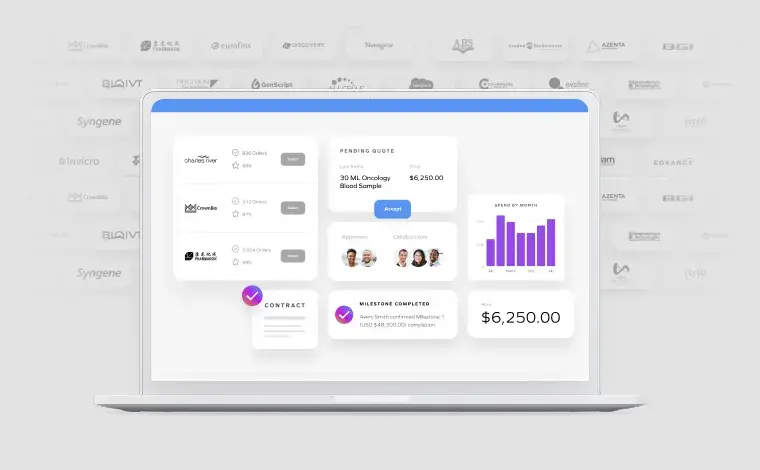
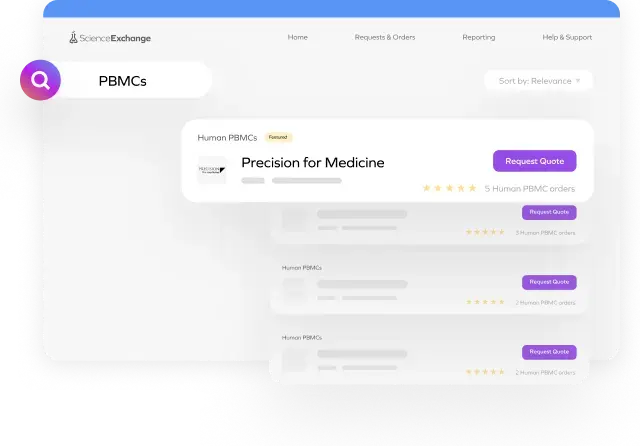
Over the first decade of partnership, Science Exchange became the unified front door for external R&D sourcing across the company’s global footprint. Researchers across sites used the same platform to scope, contract, manage, and pay for external scientific services — replacing fragmented, site-specific workflows with a standardized experience supported by unified compliance, contracting, and payment infrastructure.
Phase Two (2025–Present): Activating Cost Discipline at Scale
In 2025, the partnership entered a new phase with the launch of a dedicated Savings Initiative. Through this joint program, a Science Exchange-led team takes an active role in supplier-level cost negotiation on behalf of the company’s research teams — identifying pricing opportunities, pursuing discounts, and tracking realized savings against defined annual targets, with shared performance commitments.
One global platform for external R&D
A single interface used by 445 researchers and procurement users across 30+ sites — for sourcing, contracting, milestone tracking, and payment.
Curated supplier network under one agreement
295 actively engaged suppliers operate under a single master agreement, giving researchers fast access to specialized capability while reducing per-engagement contracting burden.
Active supplier negotiation as a service
A dedicated team identifies supplier-level savings opportunities, negotiates on the company’s behalf, and tracks realized savings against defined annual targets.
Native integration with enterprise systems
Science Exchange integrates with the company’s procurement, content management, and analytics infrastructure — including SharePoint, ELN, Ariba, and Power BI.
The Results
Compounding Adoption, Expanding Scale, and Early Proof of Savings
The trajectory of the partnership reflects a compounding model of value creation. More teams, sites, and use cases have converged onto a single platform — transforming Science Exchange from an optional tool into the default mechanism for engaging external R&D across the organization.
A growth curve, not a single moment
Completed orders processed through Science Exchange, year by year:
86
172
296
505
Annual external R&D spend grew in parallel — from approximately $5.5M in 2022 to nearly $19M in 2025, with cumulative spend now exceeding $100M.
Scale at a glance
- $100M+ in cumulative external R&D spend orchestrated through the platform since 2015
- 1,500+ R&D engagements processed end-to-end
- 295 unique suppliers actively engaged under one master agreement
- 445 active researchers and procurement users across the company’s global footprint
- ~6× growth in annual order volume from 2022 to 2025
Early proof of active savings
The Savings Initiative is still in its first year, but it has already produced a meaningful proof point: a 10% supplier discount negotiated by the Science Exchange team — on a supplier the company had been unable to secure a discount with through years of direct negotiation. The outcome is now serving as a template for similar engagements with other enterprise customers.
A Lasting Partnership
Why This Model Sustains and Scales Over Time
The durability of this partnership reflects four design principles that align with how global R&D organizations actually operate.
- Mirror the operating reality of a global enterprise. Science Exchange was deployed site by site and team by team — matching the company’s distributed structure rather than forcing a one-size-fits-all rollout.
- Integrate with the systems already in place. The platform operates inside the company’s existing enterprise stack — SharePoint, ELN, Ariba, Power BI — so adoption did not require parallel infrastructure.
- Evolve as customer priorities evolve. Phase one focused on infrastructure. Phase two emerged as procurement leadership shifted from visibility to measurable cost discipline.
- Align around measurable outcomes. The Savings Initiative is structured with shared performance targets — meaning Science Exchange has a direct stake in delivering savings, not just maintaining platform availability.
The Operating Layer Behind Modern R&D Execution
For this top-10 global biopharmaceutical company, Science Exchange has become more than a procurement platform. Over more than a decade, it has evolved into the operating layer through which external R&D is executed — connecting researchers, suppliers, and procurement in a single system that supports both scale and control.
The introduction of active savings marks the next phase. As R&D investment continues to rise, organizations are no longer looking solely for visibility into external spend — they are looking for mechanisms that directly shape outcomes.
See what Science Exchange can do for your global R&D portfolio.
Science Exchange gives global R&D organizations one platform to source, contract, govern, and pay external scientific partners — integrated with the enterprise systems you already run on, with the option to add active savings programs on top.
Book a Demo