











There's a predictable pattern in early-stage lab setup. The equipment list starts conservatively, then grows. A second centrifuge seems prudent. A backup thermal cycler feels responsible. By the time the first order is placed, the lab is spending capital on equipment it won't need for six months. Meanwhile, the item that will actually block the first experiment is still on backorder because no one identified it as a long-lead-time item early enough.
The Science Exchange Virtual Lab Manager team sees both failure modes at nearly every lab launch: teams that overbuy and tie up capital in underused equipment, and teams that underplan and discover too late that a critical item takes eight weeks to ship. The discipline that avoids both is thinking in terms of a minimal viable laboratory: the smallest set of things that need to be true to run your first experiment.
That framing may sound simple, but in practice, it requires active resistance to the instinct to prepare for everything at once.
Most early-stage labs don't fail from under-planning—they fail from over-buying. Here's how the minimum viable lab framework changes the math on startup capital.Start With One Question: What Does Your First Experiment Actually Require?
Before anything is ordered, write down the specific experiment you need to run first and work backward from it. What equipment is required? What consumables? What vendor accounts need to be active to receive the materials?
This exercise does two things. It surfaces what is truly essential versus nice to have, and it identifies interdependencies in the process. We believe the minimal viable lab should be built around what is essential. Nice to have items should get added as the science and the needs of the lab progress, not before.
The Near-Universal Equipment Essentials
Most early-stage biotech labs, regardless of science focus, share a common equipment core. These are the items the VLM team sees in nearly every lab they stand up. You may need to add/tailor this list based on the unique needs of your science:
- Cold storage: refrigerator, -20°C freezer, and/or -80°C freezer, sized to your near-term needs. Confirm electrical requirements before ordering.
- CO₂ incubators: essential for cell culture work; have a plan for backup incubation if a unit fails.
- Pipettes: across multiple volume ranges, with adequate tip supply. Tips are a high-velocity consumable; don't underestimate initial stock.
- Centrifuge: confirm rotor compatibility with your tube types before ordering.
- Thermal cycler: if PCR is any part of your work.
- Water bath and/or bead bath: near-universal for molecular biology workflows.
- Biosafety cabinet or flow hoods: if cell culture or biological work is planned; confirm certification requirements.
- Deionized (DI) water system: required for a wide range of molecular biology workflows; confirm whether your building provides access or whether you need to order a benchtop unit
Preventable Delays
Of all the mistakes the VLM team sees in lab setup, this one causes the most frustration, because it is entirely avoidable with early planning.
Getting some equipment and reagents in hand takes weeks or months from first inquiry to delivery, accounting for quotes, configuration decisions, and order processing before anything even ships. A -80°C freezer from a major manufacturer might have a six-to-eight week lead time. Specialty reagents from a single-source supplier might take even longer. If these items aren't identified and ordered before everything else, they become the constraint that holds up the entire lab launch.
To avoid equipment lead times becoming a bottleneck:
- Build your equipment and supplies list with catalog numbers and suppliers before placing any orders
- Call or check lead times for every item on the list. Don't assume "in stock" means "arriving this week". An experienced operator or Virtual Lab Manager will know most of these lead times already.
- Identify the longest lead-time items and order those first, immediately
- Identify any critical items that have no acceptable alternative and prioritize their supply above everything else
For every item on the list, identify a backup supplier or substitute product. Single-source dependency on any item, critical or not, is a risk that's easy to eliminate early.
What to consider when selecting your suppliers
The default instinct is to order everything through one or two major distributors. That's fine for common consumables. For equipment and specialty reagents, it often isn't the fastest or most cost-effective path.
Going direct to manufacturers frequently means faster lead times, better pricing, and a direct relationship with technical support, which matters when something goes wrong or a product is discontinued. Smaller specialty suppliers often carry items the major distributors don't stock or stock inconsistently.
Ordering everything from one distributor feels efficient—but it could be costing your lab in lead times, pricing, and supplier relationships that actually matter when things go wrong.Build a vendor list that reflects what your science actually requires, not just what's convenient to order from a single account. The major distributor relationship is worth having, especially given new lab discount programs, but it shouldn't be the ceiling of your vendor strategy. For early-stage labs building these relationships for the first time, the Science Exchange Virtual Lab Manager team brings an established network of pre-qualified suppliers across a wide range of capabilities, so founders aren't starting from zero.
Know Your Safety Requirements Before Day One
Safety infrastructure isn't optional, and it can't be retrofitted easily after a lab is operational.
Before your first experiments run:
- Designate a safety officer: someone on the team is accountable for compliance, not everyone and therefore no one
- Arrange disposal services: chemical waste, biological waste, and sharps disposal each have different requirements; confirm what applies to your work and have accounts in place
- State licenses and insurance: confirm what's required in your state and jurisdiction before you begin operating; some licenses have lead times of their own
- Compliance expertise: if no one on the team has direct lab compliance experience, engaging a consultant early is significantly cheaper than fixing a compliance gap after the fact
- Safety training: Identify any trainings or safety courses needed by the safety officer or team before operations begin.
The VLM team's consistent observation: Deferring safety setup doesn't just create pressure. It creates compliance gaps that can disrupt science, delay procurement of regulated materials, and introduce risk that's much harder to unwind once operations are underway.
What Can Wait
Buying conservatively is one of the highest-leverage decisions an early-stage lab can make. Capital tied up in equipment that won't be used for six months is capital not available for experiments.
The items that commonly get ordered too early (and sit unused) include: redundant backup equipment for non-critical instruments, large equipment for workflows that haven't started yet, bulk consumable stock well beyond near-term needs, and instruments purchased speculatively for capabilities you expect to need but haven't yet validated.
If you're uncertain whether you'll need a capability in the next 90 days, don't build it in-house yet. The approval and decision-making process you set up before your first order, covered in part one of this series, is what makes this disciple stick in practice.
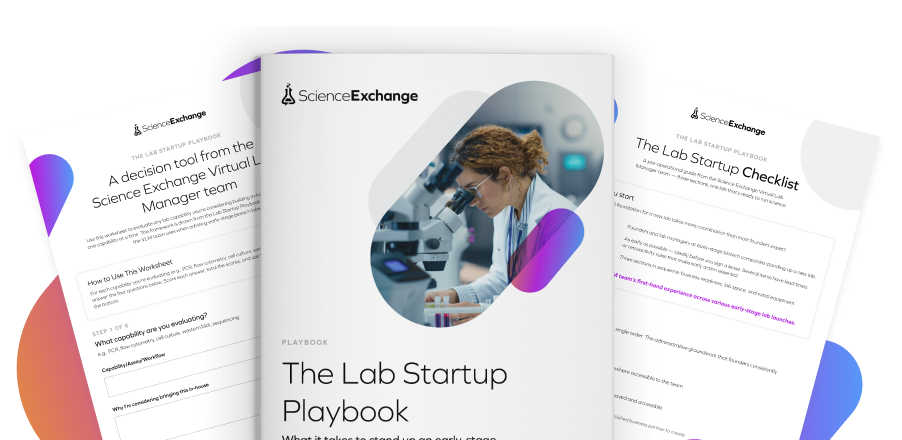
The Lab Startup Checklist covers all of this in actionable format. Use it alongside this post to make sure nothing gets missed.
The VLM team is hosting a live discussion of the full Lab Startup Playbook in July. Stay tuned for details and registration.
Next in this series: Outsource First, Build Later — the VLM framework for deciding what to run in-house versus what to send to a CRO.