Frequently Asked Questions
How do I select the right vendor for a clinical trial?
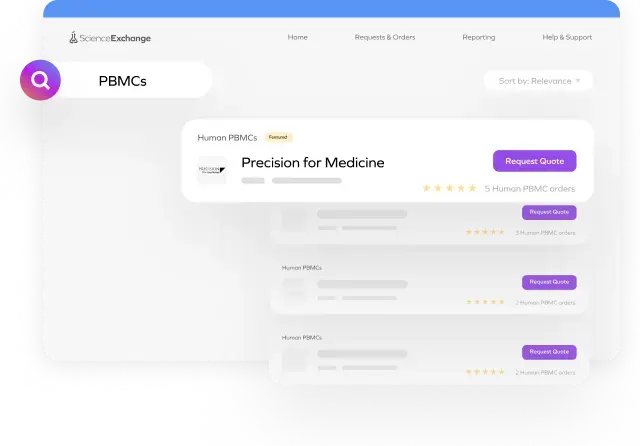
Start from your protocol, then evaluate vendors on therapeutic and assay capability, quality and regulatory track record, capacity and site coverage, data standards, and cost. On Science Exchange, clinical teams compare vendors from a pre-qualified network under one Master Services Agreement, so qualification and contracting are finished before selection and projects start in days instead of weeks.
What criteria should guide clinical trial lab vendor selection?
The core criteria are quality certifications and audit history, sample logistics and turnaround across sites, capacity for your enrollment plan, data integration with your study systems, and pricing transparency. Science Exchange keeps performance records across engagements, so each new lab selection can draw on how vendors have delivered on past studies.
What is a clinical vendor management system (VMS)?
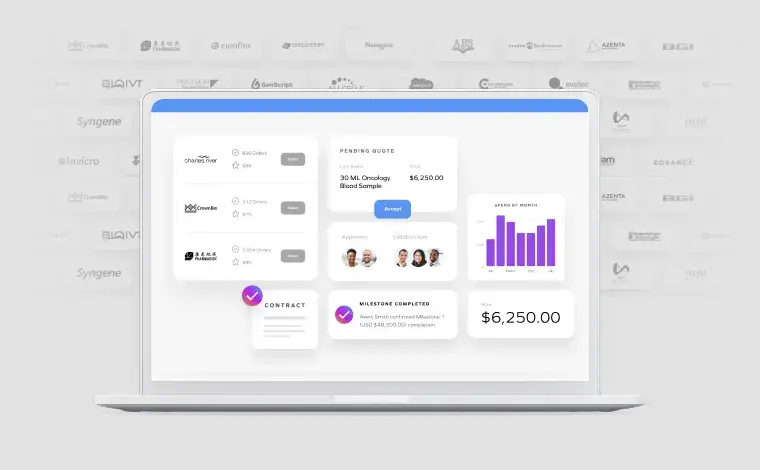
A clinical vendor management system is software that governs how sponsors select, contract, coordinate, pay, and document the outside vendors running a trial. Science Exchange provides those capabilities in one platform: vendor selection from a pre-qualified network, one agreement covering every supplier, milestone tracking, invoice matching, and a complete audit trail.
Which platforms offer end-to-end trial workflow automation with audit trails and monitoring?
Trial operations usually split between a CTMS for study execution and a separate layer for vendor workflows. Science Exchange automates the vendor side end to end: intake, approvals, contracting, milestone-based payments, and performance monitoring, with an audit trail on every transaction and approval. Spend data flows into SAP Ariba, Coupa, or Oracle.
How does Science Exchange support preclinical and clinical vendor orchestration?
The same platform governs vendors across preclinical and clinical work. Teams use one agreement, one qualification standard, and one payment path in both phases, so vendor performance data from preclinical studies carries forward into clinical selection decisions.
How does vendor orchestration improve compliance in regulated research?
Orchestration puts every vendor on the same qualification standard, contract terms, and documentation workflow. On Science Exchange, GxP and ISO requirements are built into each workflow, documentation supports FDA and EMA submissions, and every supplier interaction, approval, and payment is logged, which removes the compliance exposure that ad hoc contracting creates.
Can Science Exchange manage multi-region clinical studies?
Yes. Science Exchange coordinates clinical vendor activity across regions with central visibility into vendor performance, compliance status, budget utilization, and milestone completion, so enterprise teams run global study portfolios from one platform.
How does Science Exchange integrate with clinical trial systems?
Science Exchange connects with clinical trial management systems (CTMS), electronic lab notebooks (ELN), and laboratory information management systems (LIMS) through standard integrations, and with SAP Ariba, Coupa, and Oracle on the finance side. Vendor activity, budget tracking, and compliance documentation flow between systems without duplicate data entry.