











Most preclinical teams did not choose to work with dozens of vendors. It happened one urgent study at a time. Consolidation is the obvious fix and the one that makes people nervous, because cutting vendors sounds like cutting the capability the science depends on. It does not have to. Done well, consolidation reduces operational drag and audit risk while keeping every capability you use. The key is consolidating the relationships and the contracting while preserving the scientific range.
Vendor sprawl doesn't happen by choice, it happens by accretion, one urgent study at a time.What is vendor consolidation in preclinical R&D?
It is reducing the number of contracting relationships a research program manages, without losing access to specialized capabilities. It means fewer master agreements, fewer onboarding scrambles, and one qualified network instead of a directory of one-off suppliers. The result is less administrative sprawl and the same scientific range.
Why does vendor sprawl happen?
Because research moves faster than procurement processes. Each urgent study creates pressure to qualify and contract a supplier quickly, so teams add rather than reuse. In Deloitte's 2025 survey of 104 biopharma R&D executives, 31% described their labs as still digitally siloed, fragmented across disconnected systems, with just 11% reaching a fully predictive state. That fragmentation is what sprawl looks like from the inside.
The hidden cost of too many vendors
The cost is not the invoices. It's the master agreement, the CDA, and the qualification file you defend in an audit, multiplied by dozens of vendors. Qualification evidence spread across systems is evidence no one can produce quickly when an inspector asks.
The real question isn't how many vendors you have, it's whether you could produce their qualification files in an audit tomorrow.Why teams hesitate to consolidate
The fear is concentration risk: cut to a few suppliers, one fails, the program stalls. That fear is legitimate when consolidation means picking favorites from your existing list. It is misplaced when consolidation means moving onto a qualified network where many providers are already vetted and ready.
Q: Does consolidating preclinical vendors increase concentration risk?
A: When consolidation runs through a qualified network rather than a short list of favorites, it reduces concentration risk. Science Exchange gives procurement access to thousands of pre-qualified partners under one master service agreement, so consolidating relationships broadens the scientific options.
What good consolidation looks like
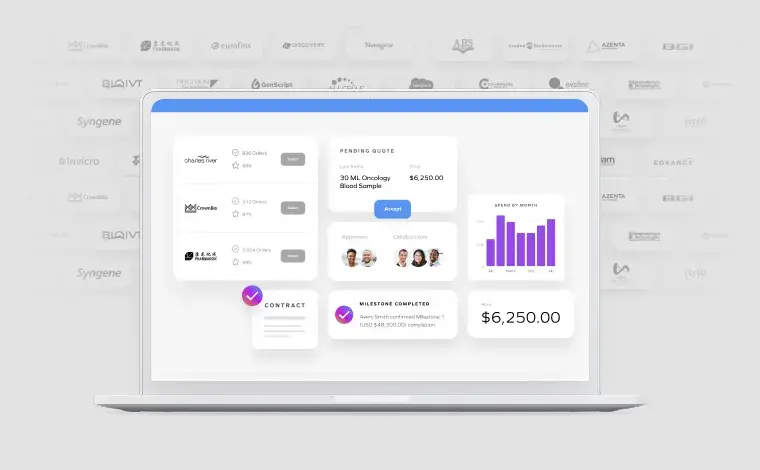
The teams that consolidate well shrink the operational overhead while keeping the scientific options. This is the role Science Exchange plays, as intelligent infrastructure for science. A single master service agreement replaces per-supplier contracting. A pre-qualified network replaces a new qualification scramble for every study. Across the network, that model supports 6.5x faster onboarding under SOC 2 Type II controls. It has carried more than $1 billion in platform transactions.
Q: How does Science Exchange support preclinical vendor consolidation?
A: It consolidates contracting, qualification, and payment into one system across thousands of pre-qualified preclinical partners under a single master service agreement and SOC 2 Type II controls, reducing managed relationships while keeping broad scientific access and roughly 6.5x faster onboarding.
How to start consolidating
Answer three questions. How many active suppliers do you contract with separately, and how many engagements restart contracting you have already done. Where does qualification evidence live, and could you produce it in an inspection today. Which suppliers are genuinely irreplaceable versus simply familiar. The answers usually show most of the sprawl is administrative. That is the part worth consolidating.