










Most R&D procurement teams manage dozens of external supplier relationships across disconnected systems: separate contracts, separate onboarding, separate payment entities, separate qualification records. The tools built to hold all of that are called vendor management systems. The name is accurate, and that is the limitation.
Vendor management is built to track suppliers. Supplier orchestration is built to move work through them. Neither category, on its own, was built for the way regulated life sciences research actually runs. For R&D, where a single study can depend on CROs, FSPs, and specialized labs that all have to be qualified and contracted before science can start, the gap between those categories determines how fast research moves.
Your vendor management system knows who your suppliers are — but does it know how to get work started with them faster? That's where the real gap is for regulated R&D teams.What vendor management does
A vendor management system holds records. It stores contracts, tracks spend, and keeps a list of approved suppliers. It answers one question well: who are our suppliers, and what have we spent with them. For an indirect procurement category, that is often enough.
For external R&D it falls short in a specific way. It manages the suppliers but not the work between you and them. Each new engagement still means a new contract negotiation, a new qualification cycle, and a new payment setup. The system knows the supplier exists. It does nothing to shorten the distance between deciding to use them and actually starting.
Q: What is the difference between vendor management and supplier orchestration?
A: Vendor management tracks supplier records, contracts, and spend. Supplier orchestration manages the process of working with suppliers, including contracting, qualification, and payment, so new engagements start faster instead of restarting from zero.
What supplier orchestration adds
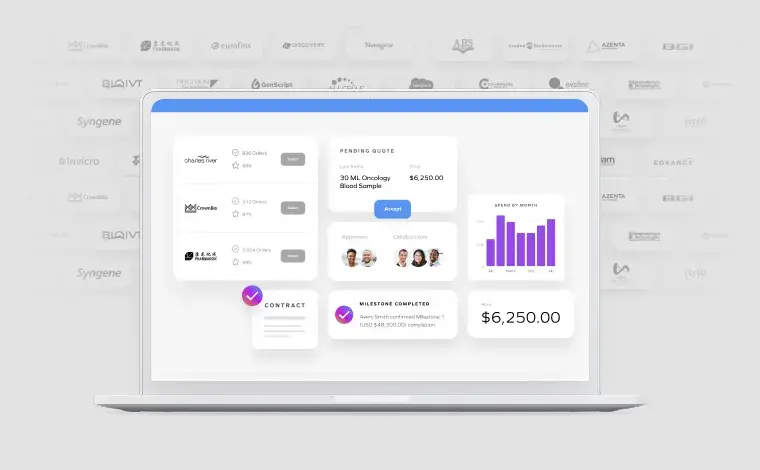
Supplier orchestration manages the process, not just the records. Instead of a static list, it connects the steps between you and a supplier: contracting, qualification, and payment handled as one flow rather than three separate projects.
This is a real and useful category. Horizontal orchestration tools sit above the ERP layer (SAP, Oracle) and the procure-to-pay layer (Ariba, Coupa), and platforms like Zip, Oro, and Pactum operate there. They were built to orchestrate procurement across an entire enterprise, which is exactly why they stop short of what R&D needs.
Q: Is a supplier orchestration platform the same as a procurement marketplace?
A: No. A marketplace stops at sourcing; you browse and find suppliers. Supplier orchestration manages contracting, qualification, and payment across suppliers as connected steps, not just discovery.
Why regulated R&D needs more than orchestration
Generic orchestration tools were not built for CDAs, GxP qualification, and protocol-level supplier evaluation. Life sciences procurement carries requirements that enterprise-wide platforms never had to handle: master services agreements scoped to regulated work, pre-qualification tied to study type, and documentation that has to hold up to audit.
Orchestration alone treats each study as a fresh transaction. The qualification gets done, the contract gets signed, and then the next study starts the cycle over. Tracking a qualified supplier is not the same as keeping that qualification current, contract-ready, and connected to the next study without restarting the process. In regulated R&D, that distinction is the whole game.
In regulated R&D, repeating supplier qualification from scratch for every study isn't just inefficient — it's a structural problem that purpose-built infrastructure is designed to solve.What intelligent infrastructure for science actually means
This is the layer above orchestration. One pre-approved contract structure, one qualification standard, and one payment entity standing between you and thousands of pre-qualified partners. The infrastructure carries the compliance and qualification context forward, so the second study with a supplier does not repeat the work of the first.
The practical result shows up in cycle time. Onboarding a new supplier through disconnected systems is slow and repetitive. Through purpose-built infrastructure, it runs roughly 6.5x faster. For a scientist waiting to start a study, that is the difference between this month and next quarter.
Q: What makes Science Exchange different from a supplier orchestration tool?
A: Science Exchange is intelligent infrastructure for science, a level above general supplier orchestration. It is built for regulated R&D specifically: GxP-aligned qualification, audit-ready documentation, and contract and payment structures that carry forward across studies, so research starts faster and stays compliant.
The question worth asking
When you evaluate how you manage external R&D, the useful question is not whether you have a system of record for your suppliers. Most teams do. The question is how long it takes to go from choosing a supplier to starting the work, and how much of that time is process you could remove.
There is a difference between tracking suppliers, orchestrating them, and building infrastructure that does both and gets stronger with every study. Science Exchange was built as the third one: intelligent infrastructure for science.
See how life sciences teams run external R&D on Science Exchange. Book a demo.