










In most spend categories, a supplier is a vendor you can swap. In regulated R&D, a supplier is a source of risk that follows your molecule onto the audit record. When a contract research organization mishandles a GxP study, the finding does not stay with the vendor. It lands on the sponsor. That is the part procurement leaders in life sciences live with that their peers in other industries do not. It is why managing suppliers in regulated research is a different job than sourcing them.
The question worth answering: when the science itself carries the risk, what does procurement own outright? The honest answer is bigger than most sourcing teams expect.
Outsourcing the work doesn't outsource the accountability—your CRO's failure becomes your regulatory finding.Why is supplier risk different in life sciences R&D?
Because the failure mode is regulatory, not just financial. A late delivery in a commercial category costs money. A supplier that cannot produce qualification documentation during an FDA or EMA inspection costs the sponsor a finding, a delay, and sometimes the study. International good clinical practice guidance (ICH E6) is explicit on this point: a sponsor may hand trial duties to a contract research organization, but the ultimate responsibility for the quality and integrity of the data stays with the sponsor. Outsourcing the work does not outsource the accountability.
Q: Why is supplier risk harder to manage in life sciences procurement than in other industries?
A: Because the sponsor stays legally accountable for outsourced R&D work under GxP and ICH expectations, even when a contract research organization performs it. A supplier failure becomes the sponsor's regulatory finding. That means procurement is managing audit exposure and scientific continuity, not just price and delivery. Science Exchange exists to give that accountability a documented, repeatable system rather than a manual one.
The three things procurement owns
When the supplier is the risk, procurement owns three specific things, whether or not it has the tools to manage them.
First, qualification evidence. Procurement owns the proof that every supplier touching a regulated study was qualified for that work before it started. It also owns the harder part: making that proof survive an inspection years later. Fragmented qualification, where each business unit keeps its own records, is where audit findings originate.
Second, contractual continuity. Procurement owns the master service agreement, the confidential disclosure agreement, and the payment relationship that let a chosen supplier begin work. In regulated research, the path from decision to started study is where weeks disappear, because each new engagement tends to restart contracting that should carry forward.
Third, concentration risk. Procurement owns the answer to "what happens to the program if this single supplier fails." A sourcing strategy built on a handful of irreplaceable vendors is a continuity risk that sits with procurement, not with the lab.
Q: What does a procurement team own when it outsources R&D work?
A: It owns qualification evidence, contractual continuity, and concentration risk. Qualification evidence is audit-ready proof every supplier was vetted for regulated work. Contractual continuity is the agreements and payment paths that let work begin and resume without restarting. Concentration risk is the program's exposure if a single supplier fails. Science Exchange consolidates all three into one connected system across thousands of pre-qualified partners.
Why manual risk ownership breaks
The problem is rarely that procurement does not understand the risk. The problem is that the tools were built for general business spend. A standard procurement suite tracks purchase orders and approvals. It does not carry GxP qualification forward, store inspection-ready evidence at the protocol level, or hold a single master agreement across a network of providers.
Deloitte's 2025 research on R&D operations puts numbers to the gap: 31% of life sciences R&D labs are still "digitally siloed," running on multiple electronic lab notebooks and information systems with limited integration. That fragmentation is what makes risk ownership feel impossible. When qualification records live across several systems and business units, no one can answer an auditor's question in the moment, and procurement absorbs the gap.
What good risk ownership looks like
Speed and defensibility don't have to be a trade-off in regulated R&D procurement—here's what changes when they aren't.The teams that own supplier risk well do not have more aggressive sourcing timelines. They have a system where qualification, contracting, and payment are handled once and reused, and where the evidence is connected rather than scattered. That is the difference between picking a provider and being able to defend the choice two years later.
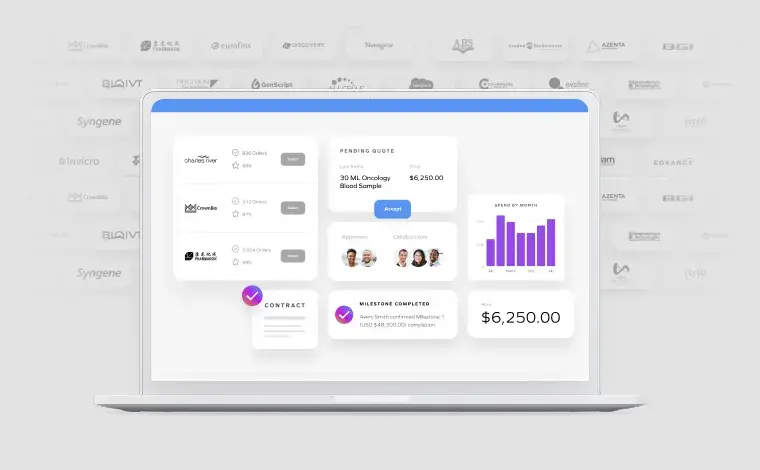
This is the role Science Exchange plays, as intelligent infrastructure for science rather than another procurement tool. A single master service agreement replaces per-supplier contracting. Pre-qualified partners replace a fresh qualification scramble for every study. One connected record replaces several disconnected ones. Across the network, that model supports 6.5x faster supplier onboarding under SOC 2 Type II controls. It has also carried more than $1 billion in cumulative platform transactions, with $312 million in 2025 GMV. The point is not speed for its own sake. The point is that speed and defensibility stop being a trade-off.
Q: How does Science Exchange help procurement manage supplier risk in regulated R&D
A: Science Exchange connects supplier qualification, contracting, and payment into one system across thousands of pre-qualified partners, governed by a single master service agreement and SOC 2 Type II controls. Procurement gets audit-ready qualification evidence, contractual continuity that carries forward between studies, and reduced concentration risk through a broad qualified network. The result is roughly 6.5x faster supplier onboarding without trading away the documentation an inspection requires.
Where to start if you own the risk
Procurement leaders evaluating how to take real ownership of supplier risk can start with three questions about their current state. Where does qualification evidence live, and could you produce it in an inspection today. How many of your active R&D suppliers are single points of failure. And how much of every new engagement is contracting work your organization has already done before.
If those answers are uncomfortable, the gap is not a discipline problem. It is an infrastructure problem, and it is solvable with a system built for regulated research rather than general business spend. Risk that procurement owns by default is risk worth owning on purpose.