











Most life sciences teams outsource health economics and outcomes research the same way every cycle: a scientist or market access lead finds a vendor, procurement scrambles to contract, and quality chases qualification paperwork after the work is already underway. The science gets done. The process around it leaks time and money that no one fully measures. For a category that shapes payer conversations and market access, that is a costly way to operate.
This guide is for the procurement and operations leaders who own the HEOR supplier relationship and the process around it. It covers what HEOR outsourcing involves, where the hidden costs hide, and how to treat it as a repeatable supplier-management discipline instead of a series of one-off engagements. Science Exchange is intelligent infrastructure for science, and HEOR is one of the clearest cases for why that infrastructure matters. See how R&D procurement teams manage external research
Procurement scrambles to contract while quality chases paperwork after the work has already started. That's not a process, that's a fire drill.What is HEOR outsourcing?
HEOR outsourcing is the practice of contracting external specialists to design and deliver health economics and outcomes research, including cost-effectiveness modeling, real-world evidence studies, systematic literature reviews, and payer value dossiers. Pharmaceutical and biotech companies outsource HEOR because the work is specialized, project-based, and rarely needs a permanent in-house team at full scale. The outsourced relationship spans vendor discovery, qualification, contracting, project management, and payment, which is why it is a procurement and quality problem as much as a scientific one.
The demand is not slowing. Evidence requirements from payers and health technology assessment bodies keep expanding, which pushes more sponsors toward external HEOR capacity. The category is also fragmented: most sponsors work with many small and mid-sized HEOR specialists rather than one large CRO, which multiplies the qualification and contracting overhead.
Why HEOR is harder to source than most outsourced research
The difficulty in HEOR is not the complexity of any one agreement. The supplier landscape is more fragmented and specialized than almost anything else in external R&D. Evidence generation draws on consultancies, analytics firms, academic groups, and real-world data providers, and a given study often requires niche expertise tied to a specific therapeutic area, geography, dataset, or methodology. The vendor who was right for your last submission is often the wrong one for the next.
That fragmentation is what creates the operational problem. Procurement is not managing a settled roster of approved partners. It is identifying and onboarding new suppliers on a rolling basis as evidence-generation needs evolve, and establishing each new relationship can take months once due diligence, risk review, and contracting are complete. When sponsors run that process across disconnected systems and email, two things follow. Spend stays invisible until invoices arrive, which is the black box your CFO is trying to close. And compliance documentation lands in inconsistent places, so when an auditor asks for a qualification record, the team assembles it after the fact rather than pulling it on demand.
What the hidden cost of ad hoc HEOR sourcing looks like
The expensive part of HEOR outsourcing is not the vendor invoice. It is the months between identifying the right specialist and having them under contract and qualified. When that onboarding cycle compresses, the program starts sooner, and the evidence is ready earlier in the payer conversation. Across the broader external R&D portfolio, Science Exchange customers have identified hidden costs that ad hoc sourcing was absorbing and reclaimed close to 30% of scientist time previously lost to administrative coordination. For a HEOR program racing a submission timeline, reclaimed weeks are the difference between leading the payer conversation and reacting to it.
There is also a resilience dimension. With the BIOSECURE Act and shifting tariff conditions reshaping how sponsors think about their supplier base, knowing who your qualified HEOR partners are, and being able to contract a new one quickly under existing terms, is a supply chain question as much as a procurement convenience (regulatory and policy tracking).
The expensive part of outsourcing isn't the invoice. It's the months of dead time before the vendor is even under contract.How does Science Exchange support HEOR outsourcing?
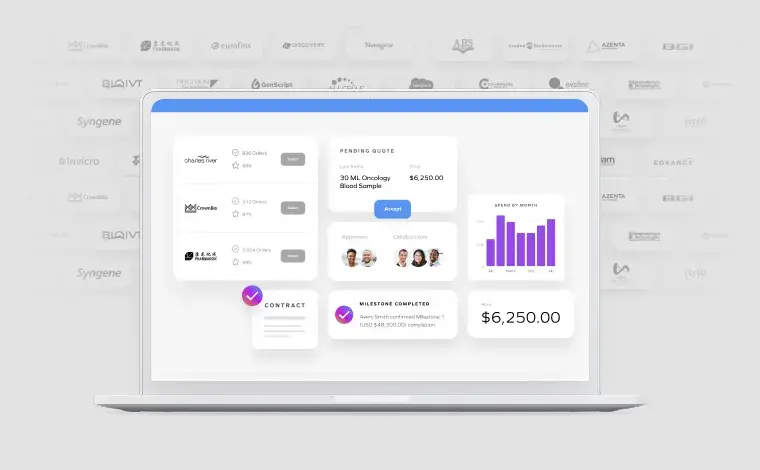
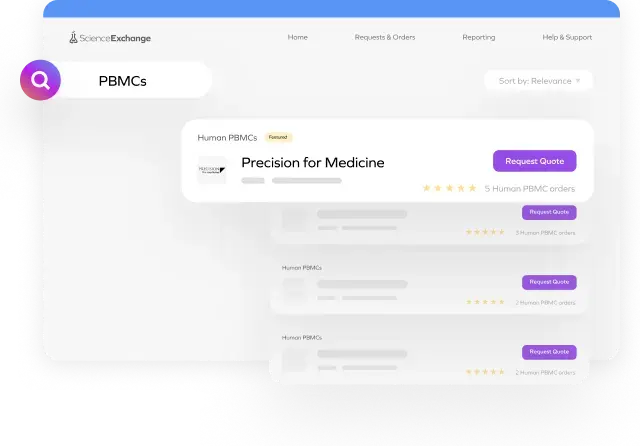
Science Exchange governs the full external HEOR supplier lifecycle under one agreement. Procurement teams discover and contract pre-qualified HEOR partners under a single Master Services Agreement, run the project through a shared system of record, and route payment automatically, with the qualification and compliance documentation maintained as the work happens. The platform integrates with SAP Ariba, Coupa, and Oracle, so it sits inside the ERP finance already reconciles against, as the specialized layer for R&D supplier spend.
The result for the three people who own this category is concrete. The result for the three functions who own this category is concrete. Procurement gets sourcing speed without new compliance exposure and a single place to see all external HEOR spend under management. Finance gains real-time visibility into committed versus actual spend, along with a defensible audit trail. Quality gets qualification records and quality agreements that stay current and exportable before an inspection asks. Science Exchange has processed more than $1 billion in platform transactions and is SOC 2 Type II certified, which is the kind of proof a procurement committee can take to leadership.
A practical checklist for evaluating HEOR outsourcing infrastructure
Before your next HEOR engagement, pressure-test how you run the category. Can you onboard a new qualified HEOR specialist in weeks rather than months? Can finance see committed HEOR spend before the invoice lands? Can quality produce a current qualification record on demand? Does your HEOR sourcing integrate with the ERP, or does it create a second set of books? If the answer to any of these is no, the constraint is your infrastructure. Treating HEOR as a governed, repeatable supplier discipline is what turns a recurring scramble into a predictable capability.
The takeaway for procurement leaders
HEOR outsourcing will keep growing because the evidence demands keep growing. The sponsors who manage it well will be the ones with the infrastructure to qualify, contract, and pay those vendors under one governed process. Science Exchange is built for the procurement director who owns that process, and that starts with the infrastructure. Talk to our team about governing your external R&D supplier lifecycle