












Over the past two decades, scientific innovation has advanced at an extraordinary pace. Genomic sequencing has become dramatically faster and more affordable, computational biology and artificial intelligence are transforming drug discovery, and new therapeutic modalities are expanding the capabilities of medicine.
Yet, while science itself has modernized, much of the operational infrastructure that supports research and development has remained fragmented, manual, and slow to evolve. One of the most persistent structural bottlenecks in life sciences today is not experimental capability, but access to it.
Modern R&D depends on a vast ecosystem of external partners: contract research organizations, specialty laboratories, data providers, manufacturers, and niche service vendors. Even the largest pharmaceutical companies rely heavily on outsourced expertise, and emerging biotechs often operate with distributed models from the start. The scientific capabilities required to advance a program frequently exist somewhere in the global marketplace. The challenge lies in identifying the right partner, qualifying them, contracting with them, onboarding them into internal systems, and managing performance over time.
These steps are administrative and collectively can introduce substantial delay.
The biggest bottleneck in life sciences R&D isn't the science—it's the fragmented infrastructure that slows access to the right partners. Here's what a purpose-built marketplace changes.The Hidden Cost of Fragmented Supplier Management
In many organizations, sourcing and onboarding a new supplier can take months. Legal negotiations are repeated across similar agreements. Compliance and quality reviews are conducted independently for each vendor. Procurement workflows vary by department, geography, or therapeutic area. Performance data, if captured at all, remains siloed within individual teams.
As a result, scientists and research leaders often spend considerable time navigating operational complexity rather than focusing on experimental design and scientific insight. Programs slow not because the necessary expertise does not exist, but because the path to engaging it is inefficient.
The issue is not scarcity of suppliers. It is the absence of cohesive infrastructure that enables rapid, compliant, and informed access to them. The real cost of fragmented supplier management extends far beyond administrative overhead—it delays programs and diverts scientific talent from the work that matters most.
The Marketplace Model as Foundational Infrastructure
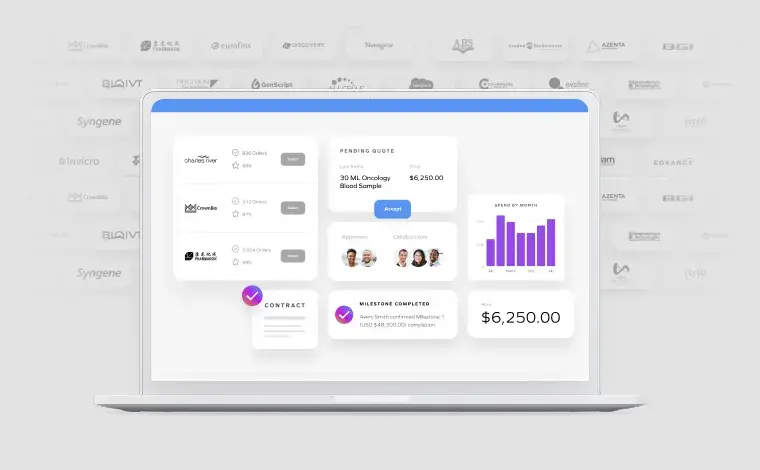
A well-designed scientific marketplace addresses this structural challenge by aggregating global capability into a pre-contracted network. Rather than beginning each supplier engagement from scratch, organizations gain access to a curated ecosystem that has already undergone quality, compliance, and risk assessment. Standardized contractual frameworks reduce repetitive negotiation cycles, while unified intake and ordering processes ensure that every transaction aligns with internal governance requirements.
The immediate impact is measurable operational efficiency. Projects can begin faster because contracting and onboarding barriers are minimized. Administrative burden declines because sourcing, ordering, and payment workflows are consolidated into a single experience. Researchers gain visibility into multiple suppliers simultaneously, enabling informed comparisons of cost, turnaround time, and historical performance.
However, the marketplace model delivers more than efficiency. It establishes a durable layer of infrastructure that strengthens the entire R&D ecosystem.
Driving Network Intelligence
When supplier engagement is centralized within a marketplace model, data accumulates across transactions. Performance metrics, delivery reliability, pricing benchmarks, and service outcomes can be observed at scale rather than in isolation. Over time, this creates network intelligence that benefits both sponsors and suppliers.
Decision-making becomes evidence-based rather than anecdotal. Patterns of reliability or inconsistency become visible. Emerging capabilities can be identified earlier. Pricing transparency improves. Suppliers are incentivized to maintain high standards of quality and responsiveness because performance is measurable.
In this way, the marketplace evolves beyond a sourcing mechanism and becomes a system of shared accountability and insight.
Expanding Access and Democratizing Innovation
Marketplace infrastructure also plays a critical role in expanding access. Smaller and emerging biopharma companies often lack the internal procurement and compliance resources required to rapidly qualify and contract with specialized suppliers. A structured, pre-qualified marketplace enables these organizations to access enterprise-grade supplier networks without building enterprise-scale infrastructure themselves.
For large enterprises, the benefits are equally strategic. Centralized supplier access reduces redundant contracting, creates consistency across business units, and enhances global visibility into spend and performance. As R&D organizations grow increasingly distributed and collaborative, this unified framework becomes essential for balancing agility with control.
By lowering barriers to supplier engagement, the marketplace model allows innovation to compete on scientific merit rather than operational capacity.
Fueling Future Scientific Progress
The trajectory of life sciences suggests that external collaboration will only deepen. Advanced therapies require specialized assays and manufacturing partners. Precision medicine depends on niche diagnostics and complex data ecosystems. Real-world evidence generation involves diverse analytical collaborators. The complexity of scientific development continues to expand.
Scientific progress depends not only on breakthrough ideas and rigorous experimentation, but also on the systems that enable expertise to flow across organizational boundaries. By transforming supplier engagement from an ad hoc process into a coordinated, data-driven network, the marketplace model addresses one of the most persistent structural constraints in modern R&D.
External collaboration in life sciences is deepening—and the organizations that invest in marketplace infrastructure now are building the architecture for faster, more agile discovery.Not All Marketplaces Are Created Equal
As marketplace models gain traction in life sciences, it is important to distinguish between simple supplier listings and true infrastructure solutions. A listing or directory may aggregate vendors, but accelerating science requires far more than access alone. The quality of the underlying framework determines whether a marketplace reduces friction or simply relocates it.
At Science Exchange, we believe that a differentiated scientific marketplace is composed of four key pillars:
- A Unified Legal Framework: A single master agreement that governs transactions across the network eliminates repetitive contracting and enables immediate project initiation, while maintaining enterprise-grade compliance and data protection standards.
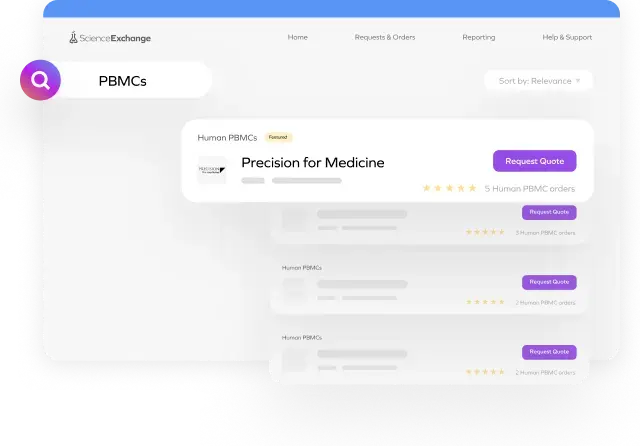
- Intelligent Supplier Sourcing/Discovery: Advanced search capabilities allow researchers to identify suppliers by specialized assays, certifications, geography, and historical performance which ensures precise capability matching in an increasingly complex scientific landscape.
- Support across the R&D Continuum: True infrastructure spans discovery, preclinical development, clinical research, through HEOR and real-world evidence, which reduces fragmentation across programs.
- Value to Suppliers & Sponsors Alike: Pipeline visibility and growth, and streamlined engagement drive efficiency for suppliers while supplier metrics and workflow optimization give sponsors greater transparency and accountability across the network, and drive productivity.
Collectively, these pillars create the foundation for a robust, secure, and differentiated marketplace that drives value to all participants. Organizations that treat digital procurement as a strategic lever—not just an operational function—are better positioned to accelerate programs and compete on scientific merit.
Concluding Remarks
As the industry becomes more interconnected and more specialized, access will increasingly determine speed. Organizations that invest in marketplace infrastructure are building the architecture required for more agile, collaborative, and intelligent discovery.
In the long term, accelerating science is not only about advancing technology inside the lab. It is about modernizing the infrastructure that connects the global scientific ecosystem.
A marketplace, when thoughtfully designed and orchestrated, becomes that foundation.