













Customer Story
Top 20 Global Biopharma Unifies Preclinical R&D Procurement Across Sites with Science Exchange
Science Exchange | 10 min read | Apr. 27 2026

Executive Summary
A top 20 global pharmaceutical company — Japan-headquartered, with operations in roughly 70 countries — had built out a preclinical research footprint through aggressive M&A: nine acquisitions in six years across five therapeutic modalities. The result was scientific breadth, but also a fragmented procurement environment. Preclinical R&D purchasing spanned more than 200 critical suppliers across five financial systems and seven global research locations from Tokyo headquarters to Boston-area biotechs, with no unified view of suppliers, spend, or onboarding status.
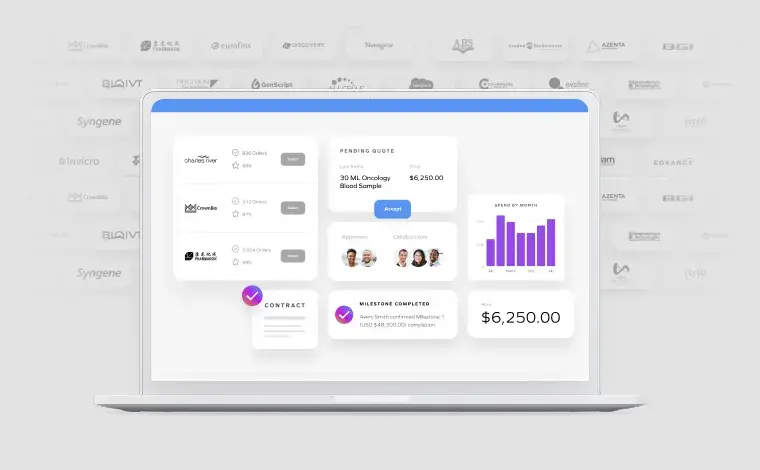
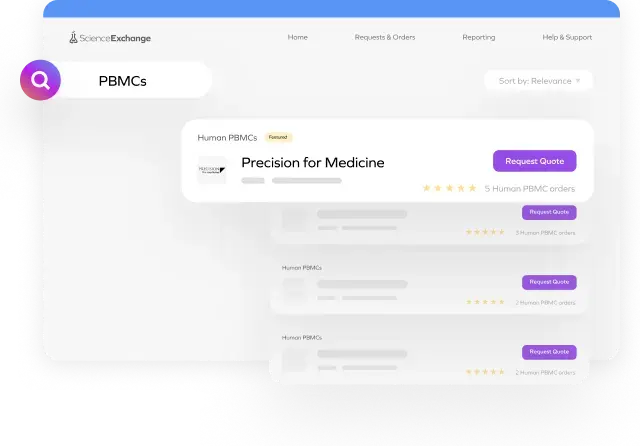
The organization selected the Science Exchange Supplier Orchestration Platform as the single interface for preclinical R&D purchasing across its global footprint. Once deployed, Science Exchange became the front door for preclinical sourcing at every in-scope site — standardizing supplier access, contracting, compliance, and payment on one system.
>80%
reduction in order activation time, from 30 days to 6 days
>$1.2M
in cost savings across approximately $50M in preclinical spend
126
unique suppliers engaged under a single standard agreement
48%
of new orders and of in-scope spend placed through Science Exchange
The Challenge
Nine Acquisitions, Five Financial Systems, Seven Sites
Growing Demand, Limited Resources
Operating across five financial systems created significant process complexity and data fragmentation, obscuring supplier relationships and spending patterns across more than 200 critical suppliers. No consolidated view of preclinical spend existed.
Administrative Burden
Lengthy supplier onboarding processes delayed scientific innovation and frustrated R&D leadership. Researchers spent material time on procurement administration rather than on the science their programs required.
Global Complexity
Coordinating procurement across seven global locations — from Tokyo headquarters to Boston-area biotechs — with diverse cultural dynamics created significant challenges for a single procurement organization trying to operate consistently at global scale.
Speed vs. Compliance
Ensuring consistent quality standards and regulatory compliance across a global supplier base supporting new therapeutic modality R&D was highly complex and difficult to track. Every acceleration risked a compliance gap; every control added friction.

Rapid M&A gave us scientific breadth across five therapeutic modalities, but it also meant we were running preclinical procurement on five financial systems with 200+ suppliers and no shared view of any of it. That is not a problem any single team can solve — it requires infrastructure.
Head of Procurement
R&D, Manufacturing and Supply Chain
The Solution
Science Exchange Supplier Orchestration Platform
A framework that aligned talent, suppliers, and operations
The organization's procurement leadership framed the transformation across three reinforcing dimensions — and Science Exchange's software supported all three.
- Talent: Redirects team capacity from tactical purchasing to strategic category work.
- Suppliers: Treats the supplier network as a capability extension, not just a vendor list.
- Operations: Standardizes the backbone so quality, cost, and speed improve together.
The Results
Measurable Transformation in HEOR Operations
Before and after: the structural shift
| Before: Fragmented & Complex | After: Unified & Efficient |
|---|---|
| 200+ suppliers across 5 financial systems | 10 suppliers in the enterprise P2P/ERP vendor master |
| Lengthy individual supplier onboarding | Instant supplier access and project start |
| Administrative burden on researchers | Researchers focused on science, not admin |
| Limited access to specialized suppliers | Global access to specialized innovation |
| Complex payment processing | Automated billing and payment processing |
Pillars of Success
Four Design Choices That Drove Adoption
On-the-Ground Alignment
Build consensus across cultures and geographies. In-person consultation prior to deployment, at every site in scope, was treated as a prerequisite — not as an afterthought. A global platform rolled out remotely would not have earned the adoption the program required.
Business-Led Technology
Solve business-identified priorities as the primary driver of the technology selected. Science Exchange was chosen because it fit the preclinical category's operating problems — not because of feature-level comparisons. This kept the effort anchored in outcomes the business cared about.
Workflow by Design
Map business processes and drive change through technology-driven workflows. The team invested heavily in documenting the preclinical purchasing workflow before deployment, so Science Exchange reinforced the target operating model rather than automating the old one.
PMO-Led Rollout
Utilize trained and dedicated PMO resources to manage the rollout and gain adoption quickly. A professional program-management function — not a distributed volunteer model — carried the cross-site coordination, training, and stakeholder management required at global scale.
Advice for Other Global R&D Organizations
Quantify the cost of fragmentation before debating the cost of the platform. The hidden cost of duplicated suppliers, redundant contracts, and delayed onboarding is almost always larger than the cost of the infrastructure that would unify them.
Frame the investment around business outcomes, not technology. A procurement platform positioned as a business transformation will earn executive support that a tool will not.
Invest in program management from day one. A dedicated PMO with cross-site authority is what converts a good platform choice into an adopted operating model.