










Nobody calls a meeting to announce they have an R&D operations problem. The realization is quieter than that. A scientist mentions, offhand, that they spent all of Tuesday chasing a supplier quote. A procurement director notices the same contract redline cycling through legal for the third time this quarter. A VP looks at the pipeline and cannot explain why a study that should have started in Q1 is still in onboarding.
We have spent years working alongside these teams. Enterprise pharma with thousands of active supplier relationships. Emerging biotech companies with six scientists and no procurement staff. The contexts differ. The friction, surprisingly, does not.
Two recent conversations made that clear: a customer panel on Virtual Lab Manager support in January 2026, and our Connected Ecosystem webinar in April. Across both, patterns emerged that are worth naming.
Most R&D teams don't know they have an operations problem — they think they have a capacity problem. The difference matters more than you'd expect.The Breaking Point Is Never Dramatic
When we asked our Virtual Lab Manager panelists, operations leaders from NewLimit and Site Tx, what prompted them to change how they handled supplier management, none of them described a crisis. No catastrophic audit failure. No project cancellation.
Instead, they described a slow accumulation. Scientists spending 10 or more hours a week on purchasing tasks. Contracts sitting in legal queues behind unrelated work. Onboarding timelines stretching from weeks into months because every new supplier required its own compliance review, its own CDA, its own payment setup.
The "breaking point" was a calendar check. Leaders looked at how their teams were spending time and realized a meaningful percentage of it had nothing to do with science.
This matters because it means most R&D organizations experiencing this friction right now do not think they have a problem worth solving. The pain is distributed across too many small tasks to register as a single, actionable issue. It shows up as a capacity problem. It is actually an infrastructure problem.
The Cost Comparison Is Simpler Than Expected
One of the most practical moments from the January panel came when panelists walked through the actual economics of hiring a full-time procurement specialist versus using virtual support through Science Exchange.
For emerging pharma teams, the math is direct. A full-time hire carries salary, benefits, onboarding time, and the risk of building a role around a problem that shifts as the company scales. Virtual Lab Manager support provides the same operational coverage, flexes with project volume, and comes with an existing supplier network and compliance framework already in place.
But the more interesting insight was what enterprise teams said. Even organizations with dedicated procurement staff described the same bottleneck: individual supplier onboarding workflows that run sequentially rather than in parallel. Every new engagement triggers a separate legal review, a separate compliance check, a separate payment configuration. The headcount is there. The infrastructure to make that headcount efficient is not.
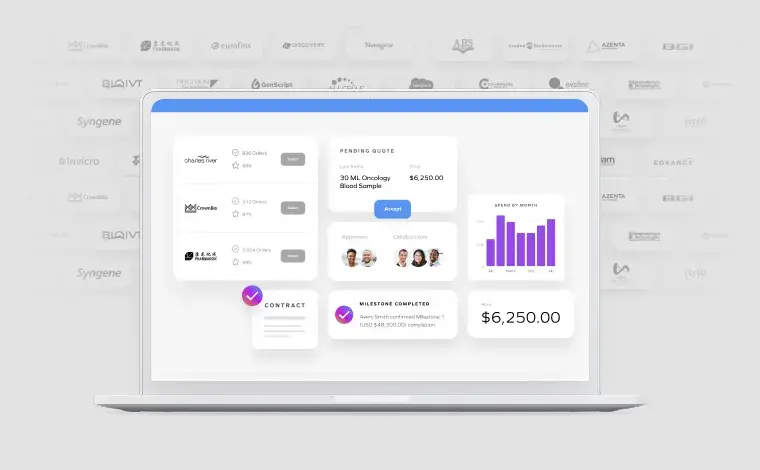
Science Exchange customers report 6.5x faster project initiation because the platform eliminates the per-supplier overhead. One master agreement covers the entire network. Compliance assessments are completed once and inherited across all customers. The speed advantage is structural, not just operational.
Procurement Onboarding Is the Bottleneck Nobody Budgets For
During the Connected Ecosystem webinar, we polled attendees on where they experience the most friction working with external partners. Procurement onboarding and approvals was the top answer, consistent with what we hear from R&D operations leaders across the industry.
This is not a new finding. But the reason it persists is worth examining.
Most organizations treat supplier onboarding as a variable cost: it takes however long it takes, and the timeline depends on the supplier, the legal team's bandwidth, and the complexity of the engagement. There is no line item in the R&D budget for "weeks lost to sequential onboarding workflows."
But the cost is real. McKinsey research suggests optimizing the preclinical path can reduce cycle time by 40% or more, translating to over $400M in risk-adjusted NPV for a typical portfolio. Supplier sourcing and onboarding sit directly on that critical path. Every week spent in contracting is a week the study is not running.
The organizations that have solved this, our customers among them, did not solve it by hiring faster lawyers or adding procurement headcount. They solved it by removing the per-supplier contracting requirement entirely. A unified legal and compliance framework where one agreement covers the entire supplier network compresses onboarding from roughly 90 days to 14 days for in-network suppliers.
Supplier onboarding can go from 90 days to 14 — not by hiring faster lawyers, but by eliminating the per-supplier contracting requirement entirely.Implementation Moves Faster Than the Decision
The last pattern is one that surprised us, though in hindsight it should not have. Across both conversations, the teams that adopted new infrastructure described implementation timelines measured in weeks, not months. The delay was almost always in the decision, not the deployment.
This makes sense. The operational friction described above is real, but it is also familiar. Teams have been working around it for years. The cost is absorbed into the rhythm of how work gets done. Changing that rhythm requires someone to make a case, get budget, and convince stakeholders that the pain is worth fixing now rather than next quarter.
Once the decision was made, onboarding moved quickly. Panelists from the January session specifically noted that the hardest part was not technical setup. It was building internal confidence that the change was necessary.
What This Tells Us
Four patterns, one throughline: the biggest obstacle to better R&D operations is not the absence of solutions. It is the difficulty of seeing friction that has been normalized.
Scientists spending hours on administrative procurement is normal. Sequential onboarding workflows for every new supplier are normal. Legal queues that add weeks to study timelines are normal.
Normal is not the same as necessary.
The teams we work with started by questioning what they had accepted. The infrastructure existed to fix it. The hard part was deciding to look.
Ready to see how Science Exchange works for your team? Request a demo to see how purchasing, supplier management, compliance, and payments work together in one platform.