















Leukopaks have become the starting material of choice for cell and gene therapies because they contain enriched white blood cell (WBC) populations, including lymphocytes, which are extremely valuable to cancer therapy and other immunotherapeutic research. Retaining stability and viability of fresh leukopak source material from collection through shipment and processing is critical to achieving optimal results for cell and gene therapy development.
Shipping delays and unexpected excursions from ideal storage temperature for a fresh leukopak can impact cell quality. Even when the impact on cell viability is negligible, unexpected changes in temperature can have a negative impact on the health of the cells, resulting in an increased risk of triggering apoptosis or changes in cell subset profiles and functionality that impact downstream performance.
Fresh leukopak stability at 4°C and controlled room temperature
Charles River conducted a study where fresh leukopak samples were collected from a random population of healthy donors (n=3) and were stored at either controlled room temperature (CRT) (in a standard shipping container) or at 4°C (in a preconditioned Crēdo storage box), and then serially analyzed for WBC viability and cellular characterization at four time points (0 hrs, 24 hrs, 48 hrs, and 72 hrs).
This study shows that WBC populations in fresh leukopak collections retain good viability (>90%) for at least 72 hours when stored at either controlled room temperature (CRT) or cold temperature (4°C). The only statistically significant observation in this study was a slight reduction in WBC viability for fresh leukopaks stored at CRT versus 4°C at the 48- and 72-hour timepoints (Figure 1). Even with this small reduction in WBC viability, both 4°C and CRT fresh leukopaks had >90% viability throughout the duration of the experiment.
Figure 1. White Blood Cell Stability in Fresh Leukopaks
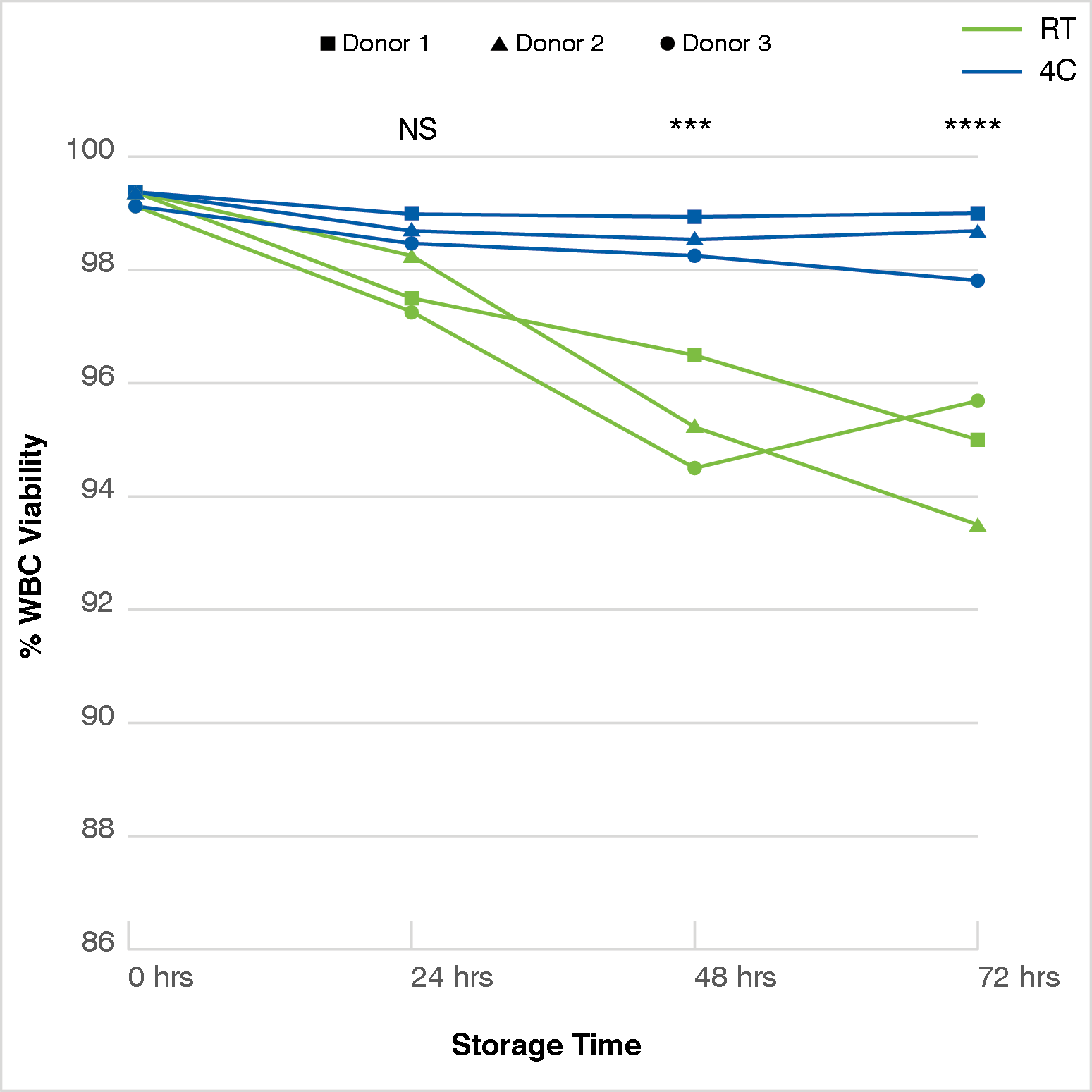
Figure1. Fresh leukopak samples stored at 4oC show a small but statistically significant higher white blood cell (WBC) viability at 48 hrs. and 72 hrs. as compared to WBC yield in leukopak samples stored at controlled room temperature (CRT). At the 24-hour timepoint, average WBC viability rates for CRT and 4°C leukopak sample sets were comparable, though samples stored at 4°C had a slightly higher viability (97.65% versus 98.63%, respectively). At the 48-hour timepoint, the fresh leukopak samples stored at 4°C showed a small but statistically significant higher WBC viability average (98.6%) as compared to those stored at room temperature (95.6%). At the 72-hour timepoint, average WBC viability was again slightly higher, with statistical significance, in fresh leukopak samples stored at 4°C (98.5%) as compared to those stored at CRT (94.7%). Data was analyzed from 3 individual fresh leukopak samples using 2-way ANOVA with Tukey's multiple comparisons test. ***p<0.0005, **** p<0.0001, NS= not significant.
Conclusion
There is some loss in WBC viability over time and therefore, 4°C would be preferred for storing leukapheresis material for longer than 24 hours. However, it would be important to take into consideration whether the slight advantage observed in WBC viability when the fresh leukopak is stored at 4°C outweighs the higher shipping costs typically associated with cold temperature shipments of fresh leukopaks such as when using preconditioned storage boxes.
It is important to note that the observed decrease in total WBC viability overtime (Figure 1) did correlate with a proportional decrease in the total cell yield for each of the different cell types examined (T cells, NK cells, B cells and monocytes). Thus, even though we saw a small decrease in the yield of these cells up to the 72-hour timepoint, the frequency ratio for each of these immune cellular subsets remained consistent overtime when compared to the total WBC population at both temperatures examined (4°C and CRT).
Additional information
Review the complete data set on fresh leukopak stability from Charles River by viewing the recent webinar “How Fresh is Fresh? A Leukopak Stability Study”. Data on immune cell subsets is presented along with information on relevant references.