











AI applications range from discovery of new targets, understanding toxicity, target-based drug design, manufacturing, and clinical trials. Some of these AI-based drug discovery efforts have proven successful[3] when the target protein is known and good quality data exists. The problem is, for many diseases, such as those arising from complex CNS pathology, the target is either unknown or there is no unique target that can provide the necessary relief. At PsychoGenics, we instead can predict efficacy for polypharmacological and/or novel compounds, using a systematic target-agnostic AI-enabled drug discovery and development platform.
Complex living systems function through the interaction of multiple overlapping and interacting pathways, which achieve homeostasis through redundancy and feedback loops. Thus, modulating a single target many times triggers a control takeover by another pathway, or adaptation through negative feedback loops, rendering the treatment ineffective. An unjustified desire for the highest single-target selectivity, compounded with the human tendency to simplify complex systems, desire to understand individual disease elements, and ignorance of physiology and CNS function leads to failures in the clinic[1]. Indeed, of all FDA-approved small molecule drugs, only 10.75% were discovered by target-based drug discovery and 89.25% by phenotype-based drug discovery approaches[2]. CNS disorders present with multiple risk factors and are unlikely to arise from a single element, and therefore phenotypic drug discovery or polypharmacological compounds can lead to effective drug discovery projects.
Whereas drugs for mental disorders have been used around the world for centuries (e.g. reserpine and psilocyn), western psychopharmacology was revolutionized in the 50s as scientists observed that non-psychiatric drugs had beneficial effects on psychiatric symptoms[3]. The discovery of chlorpromazine, and soon thereafter imipramine, opened the road to the synthesis of novel compounds and pharmacological treatment for mental diseases[4]. These drugs are an example of complex polypharmacology, as they act at many targets in the CNS (dopaminergic, serotonergic, etc.), discovered in a target-agnostic phenotypic manner.
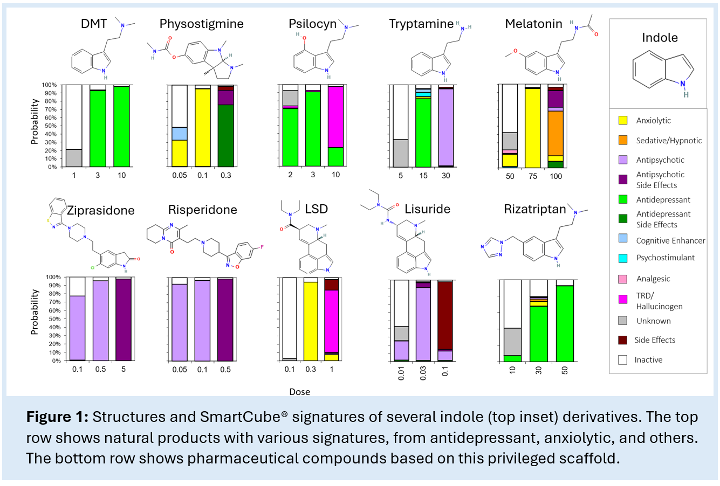
Designing compounds in silico solely based on structure and ligand data is difficult[10], but becomes an impossible feat when polypharmacology is the goal, as the optimization of PK/PD relationships at several targets at once cannot be achieved. This can be solved by a comprehensive in vivo screen sensitive to polypharmacology enabling rapid predictions about therapeutic efficacy. This strategy is captured in a few available phenotypic assays, such as PsychoGenics SmartCube® platform. As an example, of this platform output, Figure 1 shows the therapeutic signatures for several indole derivatives, obtained with SmartCube® with its prediction for several therapeutic classes.
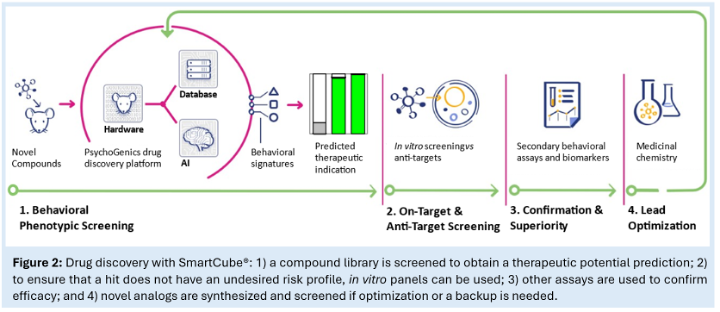
PsychoGenics’ SmartCube® is a mouse behavioral screening platform[5], based on machine learning classification of compounds’ behavioral profiles captured through 3D computer vision. Machine learning classifiers are trained using marketed drugs to define therapeutic profiles (antipsychotics, anxiolytics, analgesics, mood stabilizers, treatment-resistant depression antidepressants, etc), in a target-agnostic manner (Figure 2).
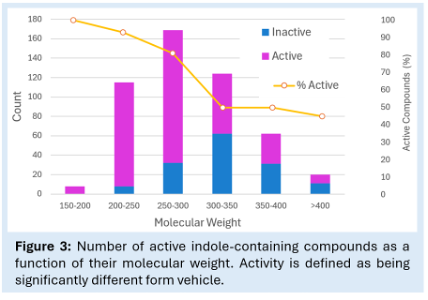
We have screened thousands of compounds from commercial or partnered libraries. Figure 3 shows the screening results of 498 indole derivatives. Whereas a diverse Lipinsky-compliant small molecules library has an activity rate between 30 and 50%, choosing indole-containing compounds with low molecular weight brings the activity rate higher than 80%. Thus, the rational design of compounds around a privileged structure, proven to deliver a polypharmacological series, combined with a fast phenotypic therapeutic prediction can lead to a successful and short path to the market.
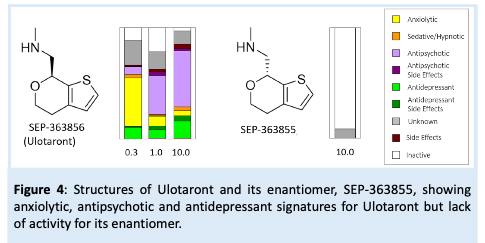
Our most advanced compound, discovered with SmartCube® in collaboration with Sumitomo Pharma (previously Sunovion), is Ulotaront, an antipsychotic with agonistic action at the 5HT1A and TAAR1 receptors and no activity at the D2 receptors [6]. Ulotaront is currently in clinical trials for various psychiatric indications.
SmartCube® can also be used to screen target-based designer drugs, and, not only small molecules, but also small peptides. Using SmartCube® for Psylin, a joint venture with Amylin Pharmaceuticals, we screened a library of small molecules leading to the discovery of PSN0041, a GLP-1 agonist with a mixed anxiolytic, and antidepressant potential confirmed in secondary preclinical assays, in addition to cognitive enhancing activity and the expected weight loss effect.
The complex interplay among multiple neurotransmitter systems, particularly in the context of the pathophysiology of CNS diseases where the underlying biological mechanisms are often poorly understood, presents a formidable challenge for to the development of new drugs for psychiatric disorders. The most effective drugs used in the clinic typically exhibit polypharmacology, modulating multiple targets simultaneously. PsychoGenics platforms can assist in several aspects of the drug discovery pipeline, from compound screening, lead optimization, and SAR development. The immense potential these methods have, promise to facilitate the discovery of drugs that are effective through unique polypharmacology.
References
- Stefan, S.M. and M. Rafehi, Medicinal polypharmacology: Exploration and exploitation of the polypharmacolome in modern drug development. Drug Dev Res, 2024. 85(1): p. e22125.
- Sadri, A., Is target-based drug discovery efficient? Discovery and “off-target” mechanisms of all drugs. Journal of Medicinal Chemistry, 2023. 66(18): p. 12651-12677.
- Lopez-Munoz, F., et al., History of the discovery and clinical introduction of chlorpromazine. Ann Clin Psychiatry, 2005. 17(3): p. 113-35.
- Chow, W.S. and S. Priebe, Understanding psychiatric institutionalization: a conceptual review. BMC Psychiatry, 2013. 13: p. 169.
- Brunner, D., Gondhalekar, V., Leahy, E., LaRose, D., Ross, W.P., Method for predicting treatment classes using animal behavior informatics, USPTO, Editor. 2009, Carnegie Mellon, University Psychogenics Inc: U.S.
- Dedic, N., et al., SEP-363856, a Novel Psychotropic Agent with a Unique, Non-D(2) Receptor Mechanism of Action. J Pharmacol Exp Ther, 2019. 371(1): p. 1-14.